
The elements of music
A Composer's Toolkit
The Take Note Music Listening and Responding Series provides rich learning experiences through the lense of the Elements of Music and how they are used by the composer to create engagement with the listener.
Our innovative digital resources equip students to recall, understand, interpret, analyse, evaluate and create in response to a composer’s manipulation of the compositional elements of music.
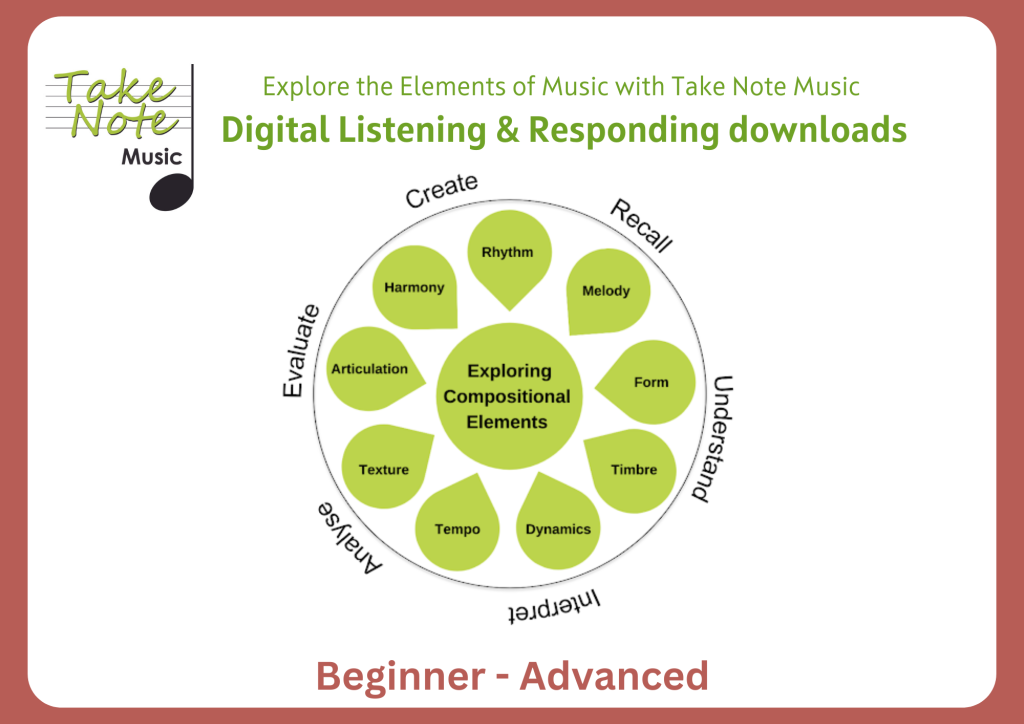
The Compositional Elements – Elements of Music diagram represents the tools that a composer uses to create interest when composing a musical work. One or more elements will be the focus for each Listening & Responding resource.
Responding to Art Music through listening, movement and the use of visual listening maps & worksheets, builds musical knowledge and appreciation in the music classroom.
The Take Note Music Listening and Responding Series provides rich learning experiences through the lense of the Elements of Music and how they are used by the composer to create engagement with the listener.
Our innovative digital resources equip students to recall, understand, interpret, analyse, evaluate and create in response to a composer’s manipulation of the compositional elements of music.
The Compositional Elements – Elements of Music diagram represents the tools that a composer uses to create interest when composing a musical work. One or more elements will be the focus for each Listening & Responding resource.
Responding to Art Music through listening, movement and the use of visual listening maps & worksheets, builds musical knowledge and appreciation in the music classroom.
Listening & Responding resources for the Primary and Secondary music classroom
rhythm
TNM LISTENING & RESPONDING RESOURCE:
Our Grieg’s Dances resource focuses on Articulation, Dynamics, Tempo, Texture, Rhythm and Harmony.
Rhythm Flashcards Again, we’ve done the hard work for you! No need to create your own flashcards!
The content relates to the Take Note Music Writing books, but also includes extra patterns for sight reading.
The flexibility music flashcards offer means teachers can create a short 5 minute music reading segment or a much longer music activity where students are reading, memorising and composing. The lesson possibilities are endless. Music lesson plans are provided in a FREE pdf ‘Flashcard Practice Activities’ below.
Melody
A melody is a linear succession of musical notes, played or sung one after another, that forms a cohesive, recognizable tune.
Often considered the most memorable or “main” part of a song, it combines pitch (high/low) and rhythm (timing) to create a distinct, horizontal melodic line.
TNM LISTENING & RESPONDING RESOURCE:
Mrs Clef eBook series introduces children to the concept of the Treble Stave and the associated note names related to melody.
This 2-part eBook series includes music lesson plans focussing on teachable moments and specific topics. Even your older primary students will remember Mrs Clef with affection. She becomes a well-loved digital experience in the lives of your students.
TNM LISTENING & RESPONDING RESOURCE:
Our Grieg’s Morning Mood Listening & Responding resource focuses on melody for middle primary through to mid secondary students. Beginning with melodic contour then identifying the pentatonic notation using solfege (sol-fa) and finally looking at other elements such as timbre and form.
Dynamics
Dynamics in music refer to the variation in loudness between notes or phrases, serving as a crucial expressive tool for performers to convey emotion. They range from very soft (pianissimo) to very loud (fortissimo), often indicated by Italian terms in sheet music. Dynamics add personality, shaping the intensity and dramatic flow of a musical piece.
TNM LISTENING & RESPONDING RESOURCE:
Listening & Responding resource Grieg’s Peer Gynt – In the Hall of the Mountain King is the most engaging resource for young children from age 7 to enjoy an active involvement listening and moving to this very exciting piece of music. The interactive video included in this resource is THE most engaging movement session ever! All you have to do is put the video on and enjoy joining in with the class. By involving the students in various movements, they are then more able to create their own beginning small to show the soft dynamics and getting larger signifying the music gradually becoming louder.
form
Musical form is the overall structure or plan of a musical composition, organized through repetition, variation, and contrast of musical sections over time. Common forms include binary (AB), ternary (ABA), strophic (AAA), and verse-chorus. Understanding form helps musicians analyze, perform, and appreciate the “big picture” of a piece.
The earliest understanding of FORM is the identification of same or different. This is experienced through different movements in a dance – relating to the changing music – and through early analysis of the rhythmic structure of short well-known songs.
TNM LISTENING & RESPONDING RESOURCE:
In the Hall of the Mountain King Listening & Responding resource focuses on the FORM Theme and Variation. Experienced through dance, it is a memorable one for the younger students.
TNM LISTENING & RESPONDING RESOURCE:
Our Grieg’s Morning Mood Listening & Responding resource focuses on Timbre and Form.
tempo
Tempo in music refers to the speed or pace of a composition’s underlying beat, usually measured in Beats Per Minute (BPM). It dictates how fast or slow music is played, profoundly influencing its mood, energy, and character. Tempo is often indicated by Italian terms (e.g., Allegro, Adagio) or precise metronome markings. In early childhood music it is simply experienced as slow vs fast.
TNM LISTENING & RESPONDING RESOURCE:
In the Hall of the Mountain King demonstrates a tempo gradually increasing from slow to fast.
The tempo of recorded music is another way of demonstrating how some orchestras will perform the music slightly slower or faster than others.
TNM LISTENING & RESPONDING RESOURCE:
Our Grieg’s Dances resource focuses on Articulation, Dynamics, Tempo, Texture, Rhythm and Harmony.
texture
Texture in music refers to how melodic, rhythmic, and harmonic materials are combined in a composition, determining the overall quality, “thickness,” or “thinness” of the sound. It describes the number of layers (voices or instruments) present and how they interact, ranging from a single melodic line to complex, dense polyphony.
TNM LISTENING & RESPONDING RESOURCE:
Our Grieg’s Dances resource focuses on Articulation, Dynamics, Tempo, Texture, Rhythm and Harmony.
articulation
Articulation in music refers to the stylistic techniques that determine how individual notes or phrases are attacked, sustained, and released, acting as musical “punctuation” to define character and expression. It influences the length (short/long), connection (smooth/detached), and intensity of notes. Key types include staccato, legato, and accents.
TNM LISTENING & RESPONDING RESOURCE:
Our Grieg’s Dances resource focuses on Articulation, Dynamics, Tempo, Texture, Rhythm and Harmony.
harmony
Harmony in music is the simultaneous sounding of two or more notes, providing depth, color, and emotional context to a melody. It functions vertically through chords and horizontally through chord progressions, acting as the foundation of Western music. Harmony adds “flavor” to music, ranging from stable, pleasing intervals (consonance) to tense, unstable ones (dissonance).
Harmony acts as the vertical dimension to the horizontal dimension of melody, working together to create a complete musical experience.
TNM LISTENING & RESPONDING RESOURCE:
Our Grieg’s Dances resource focuses on Articulation, Dynamics, Tempo, Texture, Rhythm and Harmony.